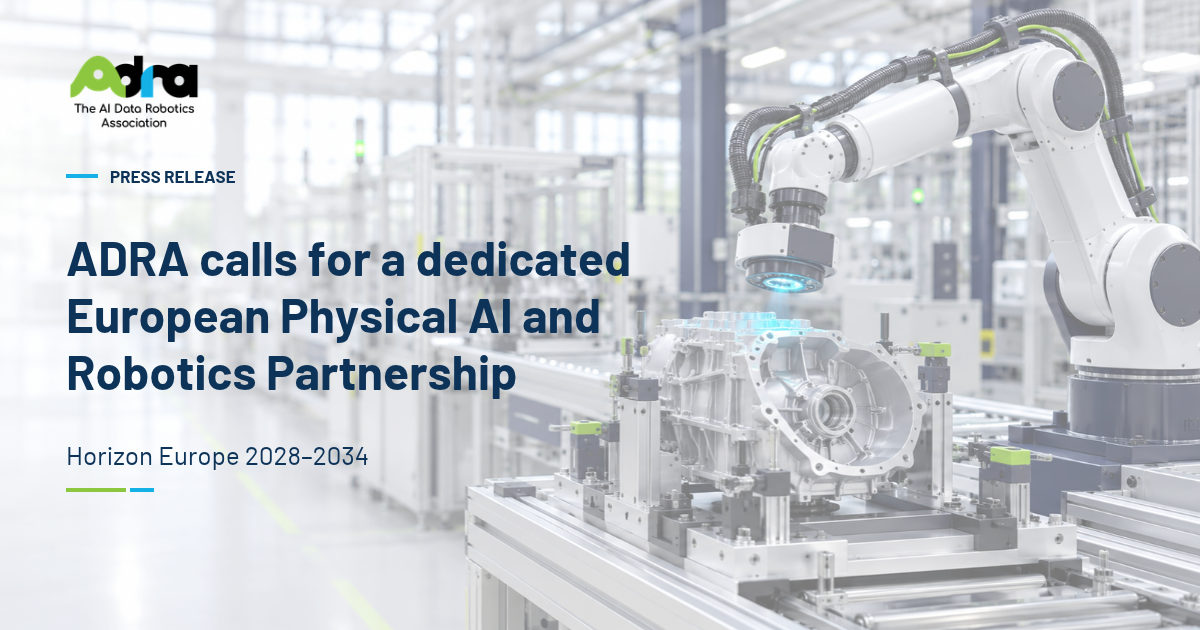
The European Commission is preparing to define its 2028–2034 European Partnership portfolio. ADRA calls for a strong, dedicated Physical AI and Robotics Partnership, arguing that this is Europe's best opportunity to secure global leadership in the technologies shaping the future of industry.
Brussels, 10 November 2026 – ADRA, the AI, Data and Robotics Association, today called for a strong, dedicated Physical AI and Robotics Partnership in Horizon Europe 2028–2034. The call is set out in ADRA's response to the European Commission's consultation on the future of European Partnerships and the associated position paper. ADRA argues and provides evidence for Physical AI being Europe’s best shot to lead globally.
The timing is critical. The Commission aims to agree the shape of its partnership portfolio by the end of this year, and a legislative proposal for future joint undertakings is expected around the turn of the year. The partnerships it chooses will launch in 2028 and run until 2034.
One partnership, with the right scale and agility
ADRA recommends a partnership that:
Keeps AI, data and robotics together in one partnership and one strategy, because they form a single value chain;
Capitalised at least as ambitiously as the Chips partnership, whose combined budget approaches €11 billion, of which €4.175 billion is the EU contribution;
A legal form that ensures scale and agility to start in 2028 at full speed;
Coordinates closely with chips, cloud and connectivity, and with advanced manufacturing.
Europe's opportunity, and a widening gap
Physical AI is where artificial intelligence, data, micro processing, sensing, connectivity, and robotics converge in machines that perceive, learn and act in the physical world. It depends on what Europe already has: a world-class industrial base, the real-world data it generates, and thousands of specialised SMEs that lead their niches in global value chains.
But the gap is widening and we must act fast. In 2024 Europe produced three notable AI models, against 40 in the United States and 15 in China. Europe's industrial robot installations fell 8% to 85,000 units, while Asia took 74% of new deployments worldwide.
“Physical AI is where Europe can lead rather than follow,” said Emanuela Girardi, President of ADRA. “This is not only a question of competitiveness. It is about Europe's freedom to make its own choices, decide what technology is for and shape its future according to its own values. Europe knows how to build these technologies; it must also choose why.”
Industry, both established and emerging, shares that view. “Europe already possesses one of the world's most advanced manufacturing ecosystems. This should become our strategic advantage.” said Jim Mainprice, Senior Manager, Artificial Intelligence, Bosch Corporate Research.
Built on evidence from European industry
ADRA's position draws on two parallel consultations. One gathered industrial end-users in ten sectors, from automotive and aerospace to mining and vessel construction. The other gathered the practitioners who would build, certify and support their systems.
Together they identified thirteen recurring barriers to deploying AI and robotics. The clearest finding is a market signal: given a genuinely competitive European alternative, European industry would buy European. It consistently reports that this alternative does not yet exist at the scale it needs.
European innovators warn that the window to act is narrowing. “Europe risks facing accelerated industrial entry by non-EU robotics players if it does not act before market structures are locked in,” said Daniele Pucci, Co-founder and CEO, Generative Bionics.
For any technology, but especially for hardware, the challenging step from prototype to product is the steepest to climb: “Hardware companies require larger upfront investments, longer development cycles, and more complex supply chains,” said Bram Verhoef, Co-founder and VP Customer Engineering & Success, Axelera AI.
As a result, Europe must tackle the bottlenecks of early-stage innovation but also provide access to scale-up capital and the market, to transform these promising startups into global leaders.
From innovation to industrial scale
The partnership ADRA proposes would build the missing path to scale. It would:
Define industrial needs, through an end-user-led Catalyst that sets pan-European challenges;
Pool demand by establishing a “buyers' club”, with public support co-underwriting the riskiest research;
De-risk the bridge from prototype to product (TRL 4 to 9) in tranches released against outcomes and evidence;
Validate and qualify solutions through Robotics Skills Qualification Centres and shared, standardised testing facilities;
Connect to the Apply AI Strategy, the European Competitiveness Fund and the Scaleup Europe Fund.
ADRA’s position also benefits from the strong political support of the European Parliament, with Brando Benifei, Member of the European Parliament (S&D, Italy) and AI Act co-rapporteur stating: “Physical AI is where Europe's digital rulebook meets its industrial backbone (and ) our advantage will not come from replicating others' race for scale, but from turning trustworthy AI, robotics excellence and high-quality industrial data into deployable systems…”
Next steps
“We believe that you need a partnership model that starts from industrial needs, pools demand and funds the road to the lead customer(s). Decision-makers are currently debating the right approach and we want to ensure that competitive European offerings are more easily discovered by the market” said Philip Piatkiewicz, Secretary-General of ADRA.
ADRA has submitted its position paper to the Commission's consultation and will work with the Commission, Member States and the European Parliament as the portfolio takes shape. Its members – industry, SMEs, research organisations and universities across Europe – are ready to help shape the strategy, mobilise industrial demand and become the vehicle for implementation.
Download the full position paper and press release below.
Notes to editors
About ADRA. ADRA – the AI, Data and Robotics Association – represents corporate industry, Mid-caps, SMEs and start-ups, research and technology organisations and universities working on AI, data and robotics in Europe. It is the private-side partner in the co-programmed AI, Data and Robotics Partnership under Horizon Europe. adr-association.eu
About Physical AI. Physical AI is artificial intelligence that perceives, reasons about and acts in the physical world, through robots, autonomous vehicles, drones and other embodied or interconnected systems. Unlike AI centred on text, images or video, it must be built around real-world physics, and its deployment depends on advances in materials, computation, sensing and actuation.
The position paper. Response to the European Commission Public Consultation on the Future of European Partnerships (October 2026), with Annex I, The Complexity of Deploying AI and Robotics for European End-Users.