The European AI-Enabled Robotics Catalyst is a proposed, end-user-led initiative developed by the AI, Data and Robotics Association (Adra) and SPRINT Robotics to accelerate the adoption of AI-powered robotics across European industry.
The Catalyst brings together industrial end-users, technology providers, integrators, research organisations and investors to address shared deployment challenges. Its ambition is to turn Europe's technological strengths into measurable industrial value by enabling solutions to be deployed faster, more reliably and at scale.
The initiative is endorsed by the European Commission and recognised in the EU's Apply AI Strategy.
Why the Catalyst is needed
Europe has world-class robotics research, innovative technology providers and a strong industrial base. Yet turning promising technologies into reliable, large-scale deployments remains a major challenge.
Industrial companies face common barriers: unreliable performance in real-world conditions, high integration costs, limited interoperability, vendor lock-in, skills shortages, uncertain return on investment and difficulties sharing industrial data while protecting intellectual property.
Many of these challenges cannot be efficiently addressed by individual companies alone. By bringing together industrial demand across sectors and countries, the Catalyst aims to remove shared obstacles, strengthen European supply chains and accelerate the uptake of trustworthy AI-enabled robotics.
From industry consultations to launch
The Catalyst is being developed through a collaborative, bottom-up process, ensuring that its priorities and operating model reflect the needs of those who will ultimately deploy robotics solutions.
2025: Identifying industry needs
The Catalyst concept was shaped through a series of end-user roundtables organised by Adra and the European Commission’s AI Office in 2025. These discussions brought together major industrial players from across Europe, including Airbus, ArcelorMittal, ABB, BMW, Bosch, Daikin, Johnson & Johnson, Leonardo, Navantia, Renault, Roche, Safran, STMicroelectronics, Thales and Valeo. The roundtables identified common barriers to the adoption of AI-enabled robotics, opportunities for collaboration and the enabling capabilities needed to accelerate deployment. These findings laid the foundations for the Catalyst’s end-user-driven model.
2026: Refining and validating the concept
Building on the initial findings, further consultations helped refine the Catalyst's objectives and operating model. Across 2025–2026, 25 major industrial companies, including Airbus, BASF, BMW, Bosch, Michelin, Renault, Safran and Thales, were consulted. These exchanges validated the demand-driven approach and highlighted the value of joining forces on shared challenges, particularly interoperability, data governance, reliable performance, integration costs and scalable deployment.
Q1 2027: Founding workshop and programme definition
The next milestone is a two-day founding workshop bringing together a first group of committed industrial end-users. Participants will jointly prioritise opportunities, establish the initial programme portfolio and shape the Catalyst's governance and operating model. The workshop will lay the foundations for the Catalyst's operational launch in 2027.
How the Catalyst will work
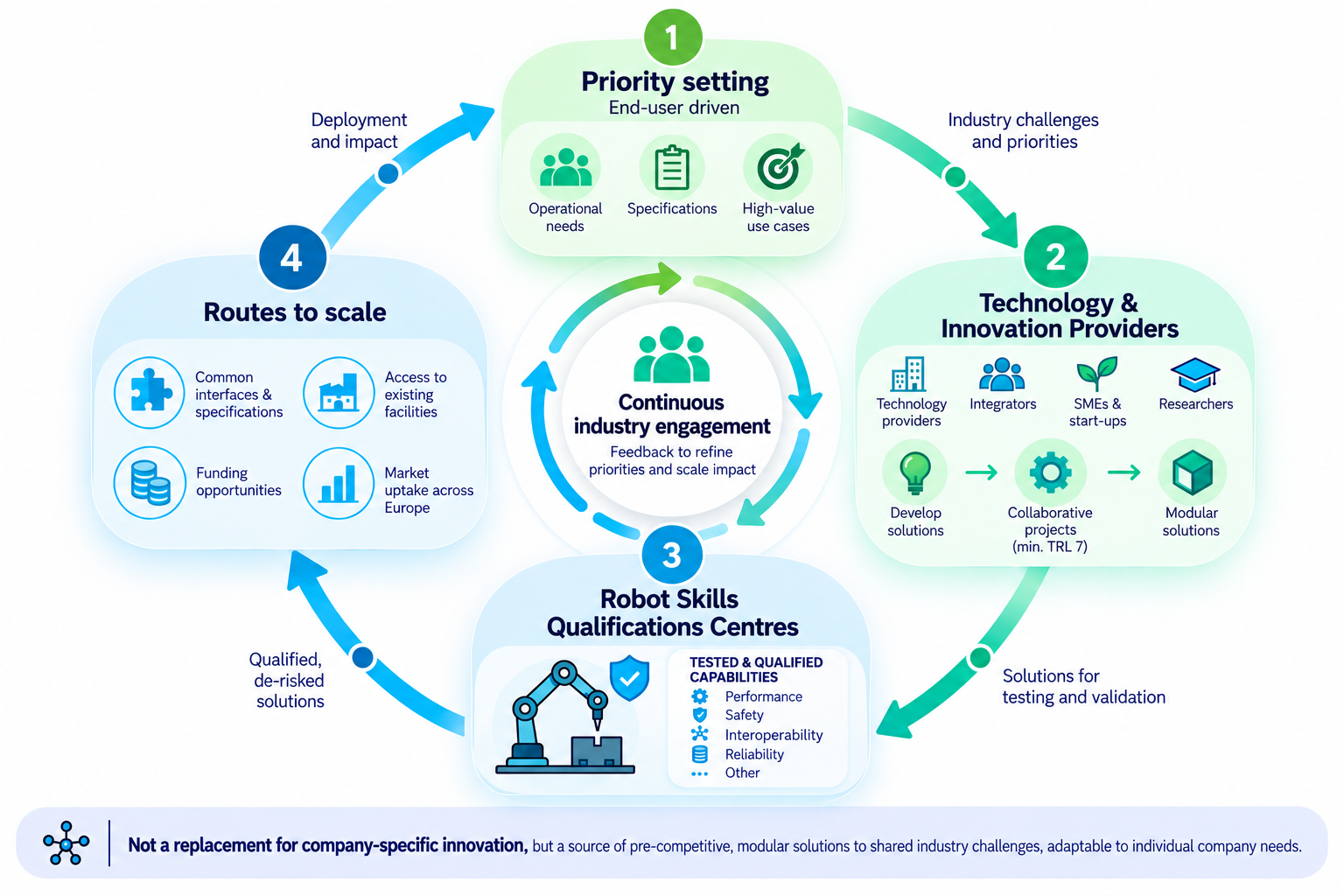
The Catalyst will operate through a continuous, end-user-driven process, connecting industrial needs with European technology providers and creating pathways for qualified solutions to reach the market at scale.
The model consists of four interconnected stages:
- Priority setting – driven by industrial end-users. Participating companies identify shared operational needs, define requirements and prioritise high-value use cases. These form the basis for a common industrial agenda.
- Technology development – mobilising the innovation ecosystem. Technology providers, integrators, SMEs, start-ups and researchers collaborate to develop solutions addressing the identified challenges. Projects aim to deliver practical, modular solutions ready for industrial validation.
- Independent testing and qualification. Robot Skills Qualification Centres (RSQCs) support the evaluation of robotic capabilities against common criteria, including performance, reliability, safety and interoperability. This provides comparable evidence, reduces deployment risks and builds confidence among industrial buyers.
- Routes to scale – accelerating market uptake. Common interfaces and specifications, access to existing testing facilities, investment opportunities and coordinated industrial demand help successful solutions move towards wider deployment across European industries.
Continuous industry engagement connects all four stages. Feedback from industrial deployment informs future priorities, refines technical requirements and helps scale successful approaches.
The Catalyst will focus on shared, pre-competitive challenges, complementing rather than replacing company-specific innovation. Participating end-users will retain control over their proprietary data, intellectual property and commercial decisions, while benefiting from reusable solutions and capabilities developed through collaboration.
Robot Skills Qualification Centres
Independent testing and qualification can support the Catalyst's programmes by providing reliable, comparable evidence of robotic capabilities.
The proposed Robot Skills Qualification Centres (RSQCs) would evaluate reusable robotic skills against common criteria for performance, reliability, safety and interoperability.
This approach could help industrial users compare solutions objectively, reduce procurement risks and avoid repeating costly validation processes across companies and sites.
Testing, qualification and competitive technology challenges will serve as tools within the Catalyst's broader mission, deployed wherever they can accelerate industrial uptake.
Turning collaboration into tangible results
The Catalyst aims to deliver practical assets that participating companies can apply directly in their operations.
For example, manufacturers interested in scaling robotic bin picking could jointly develop common integration specifications, performance-evaluation methods, procurement templates and operator-training materials. Each company would then be able to use these shared foundations for its own deployments, while retaining control of commercial decisions and confidential production data.
For industrial end-users, this means faster deployment, lower integration costs and reduced investment risk. For European technology providers and integrators, it creates clearer market demand, more predictable requirements and opportunities to scale across multiple companies and countries.
Success will be measured by real-world outcomes: shorter deployment times, lower costs, dependable operation and more successful industrial installations – rather than simply the number of pilots launched.
Next steps: building the Catalyst together
The founding workshop, planned for Q1 2027, will bring together a small group of committed industrial end-users to translate the validated concept into an actionable programme portfolio.
Participants will be invited to identify priority deployment opportunities, shared barriers, potential deployment scale and the resources they can contribute.
The workshop aims to define an initial portfolio of programmes, each with an industrial lead, participating organisations, clear deliverables, resource commitments and a 6–12-month implementation plan.
The Catalyst is expected to begin operations in 2027 with a small group of committed end-users, supported by industry co-investment and complementary public funding where appropriate. This initial phase will establish a practical operating model that can subsequently expand to more industrial participants and the wider European robotics ecosystem.
Interested in helping shape the Catalyst?
Industrial end-users interested in contributing to the founding workshop and the first programmes are invited to contact:
Adra: Michał Rybacki – michal.rybacki@adr-association.eu
SPRINT Robotics: Niels Westendorp – niels.westendorp@sprintrobotics.org